
Home › Our Mission › ASI Implementation Strategy
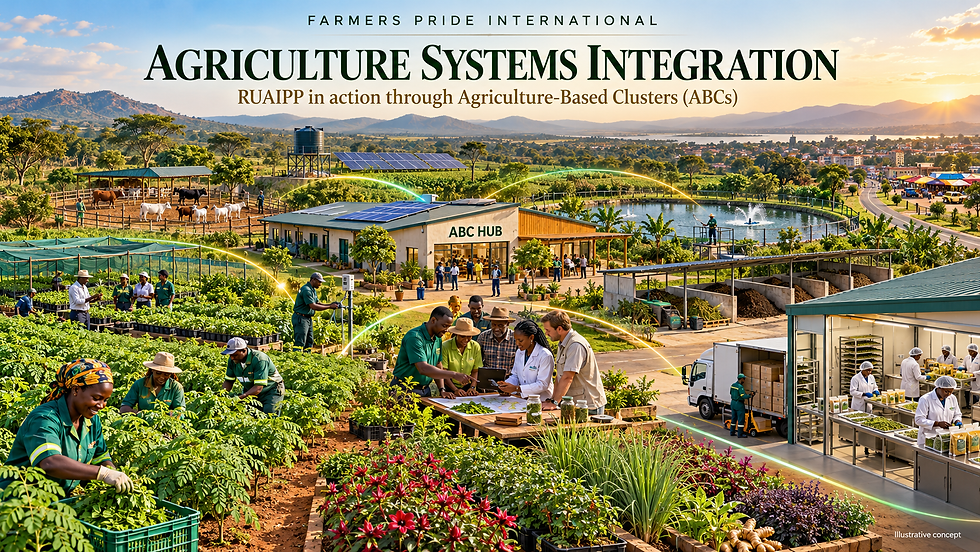
FPI is deploying the Agriculture Systems Integration (ASI) a practical approach for implementing the Rural and Urban Agriculture Innovative Production Programme (RUAIPP) through its flagship Agriculture-Based Clusters (ABCs).
Within this framework, farmers, cooperatives, schools, processors, service providers, researchers and commercial partners participate in a coordinated agricultural system. Production is planned alongside training, infrastructure, resource management, processing, quality requirements and market demand.
The objective is to create functioning agricultural enterprises that contribute to food security, employment, local value addition and sustainable economic development.
RUAIPP in Action Through Agriculture-Based Clusters
RUAIPP is implemented through Agriculture-Based Clusters (ABCs) using Agriculture Systems Integration (ASI) to align production, resource cycles, value addition, and global market access.
A Strategic Framework: RUAIPP, ABCs and ASI

The Rural and Urban Agriculture Innovative Production Programme (RUAIPP) is more than a farming initiative—it is a practical blueprint for turning local potential into lasting economic power. By connecting production, skills, technology, finance, processing, quality standards, and market access, RUAIPP helps communities move from scattered effort to coordinated growth. Explore the framework to see how each moving part works together—and how your participation could help shape the next generation of agriculture.
RUAIPP: The Strategic Vision

ABCs: The Operational Engine
Agriculture-Based Clusters function as the local operating engine of RUAIPP, bringing farms, enterprises, service providers, and community leaders into one coordinated system. Within each ABC, participants can share infrastructure, technical services, production planning, storage, processing, finance, and market access instead of working in isolation. This structure helps turn scattered agricultural activity into dependable supply, stronger local businesses, skilled jobs, and measurable community value. By linking farm-level performance with wider commercial opportunities, ABCs give producers a practical pathway from production to value addition and long-term growth.

ASI: The Synchronized Approach
Agriculture Systems Integration (ASI) is FPI’s methodology for connecting every stage of the agricultural value chain into one coordinated and synchronized system. It ensures that resource management, primary production, post-harvest handling, industrial processing, logistics, certification and global market access operate as interconnected parts of a single economic engine.
Rather than treating farming as an isolated production activity, ASI aligns what is produced, how it is produced, how it is processed, where it is sold and how value is retained. Water, soil, energy, technology, infrastructure, finance and market intelligence are integrated from the beginning so that production responds directly to verified industrial and commercial demand.
Through ASI, FPI creates a seamless flow from resource to production, production to processing, processing to certification, and certification to market penetration. This reduces waste, improves productivity, strengthens traceability, supports consistent quality and gives farmers and enterprises a clearer pathway into premium domestic and international markets.
ASI is therefore more than an agricultural methodology—it is the operating system behind FPI’s Agriculture-Based Cluster model. It synchronizes farmers, processors, logistics providers, financiers, certification bodies and buyers around one shared objective: building commercially viable, bio-industrial agricultural ecosystems capable of competing globally while retaining greater value locally.
Join FPI in building agriculture as a connected economic system—not simply a farming activity. Through ASI, we move from fragmented production to synchronized industry, from isolated farmers to integrated enterprises, and from raw commodity exports to globally competitive value chains.
RUAIPP serves as the blueprint, ABCs provide the operational engine, and ASI acts as the nervous system connecting every agricultural node.
The Central Role of Agriculture-Based Clusters
The ABC is the primary economic hub where diverse stakeholders—including smallholders, technical experts, and industrial off-takers—unite under a single management framework to maximize efficiency and shared value.
1. Mobilizing Human Capital and Governance
Each ABC brings farmers, local enterprises, and community leaders into a clear operating structure. Roles, responsibilities, and shared decisions are agreed early, helping participants coordinate resources, reduce duplication, and build trust. This strong foundation makes it easier for the cluster to attract technical support, finance, training, and reliable market opportunities.
Production is coordinated across the cluster so farmers can plan with greater confidence and respond to real market demand. Shared crop calendars, input planning, field data, and quality targets help reduce waste, improve consistency, and protect supply. Technical teams help participants select suitable crops, manage planting cycles, monitor performance, and improve practices through timely advice. The cluster can coordinate equipment, seeds, irrigation, storage, and transport, reducing delays and lowering costs for individual farms. Farmers also gain a clearer path to training, finance, certification, processing, and dependable buyers. By combining local knowledge with practical systems and measurable targets, each ABC creates a stronger production base that supports better pricing, job creation, food security, and long-term growth for participating farms.
2. Precision Production Coordination
3. Deployment of Shared Technical Services
Shared technical services give every participating farm access to support that would be difficult to afford alone. The cluster can coordinate mechanization, irrigation planning, soil testing, agronomy advice, maintenance, digital records, and field monitoring through one organized service network. This helps farmers use equipment and inputs at the right time, solve production problems faster, and improve decisions with reliable data. It also creates local technical jobs and builds practical skills, while shared services lower operating costs, reduce downtime, and raise the quality and consistency of output across the ABC.
4. Integrated Value-Addition Logistics
Integrated logistics helps move crops from harvest to market with less waste, fewer delays, and greater value for producers. Collection points, grading, storage, cold-chain planning, transport, and processing are coordinated so quality is protected from the field to the buyer. Instead of selling only raw produce, ABC participants can develop cleaned, dried, packaged, or processed products that meet clear market requirements. This creates new income opportunities, supports local processing jobs, extends shelf life, and gives farmers a stronger position when negotiating with processors, retailers, exporters, and institutional buyers.
5. Global Quality Assurance and Pedigree
Global quality assurance gives every ABC a clear system for producing goods that buyers can trust. Shared standards cover seed and input traceability, production records, food safety, grading, packaging, storage, and responsible handling from farm to final market. Regular inspections, testing, documentation, and corrective action help participants meet certification and export requirements while protecting the reputation of the network. A strong pedigree also shows where products come from, how they were produced, and which quality controls were followed—making it easier to build long-term relationships with retailers, processors, investors, institutions, and international buyers.
6. Strategic Market and Financial Brokerage
Strategic market and financial brokerage connects ABC producers to the relationships, capital, and commercial opportunities needed to grow. The network can coordinate buyer introductions, supply agreements, investment conversations, blended finance, working capital, insurance, and payment planning around real production capacity. Market intelligence helps participants understand demand, pricing, timing, and risk before they commit resources. By bringing credible information and trusted partners together, the ABC can negotiate from a stronger position, unlock expansion finance, improve cash flow, and turn reliable production into long-term enterprise growth.
Systemic Integration Across Two Tiers

The Micro Level: Farm-Gate Efficiency
At the farm level, we optimize the synergy between soil health, water conservation, livestock synergy, and waste upcycling to create a self-sustaining bio-dynamic unit.

The Macro Level: Ecosystem Synergy
At the cluster level, we aggregate multiple farms to achieve industrial scales of economy, utilizing shared processing infrastructure and unified branding to dominate market sectors.
The RUAIPP Implementation Pathway
Step 1: Stakeholder Mapping and Cluster Formation
Potential participants and local enterprises are mapped within a specific geographic zone and united into a formal Agriculture-Based Cluster structure.
Primary Result: A legally registered ABC with committed members.
Step 2: Resource Inventory and Integrated Planning
Technical teams survey soil, water, and assets to design a unified production schedule that aligns every farm with the cluster's collective goals.
Primary Result: A data-driven cluster operational blueprint.
Step 3: Capacity Building and Ecosystem Infrastructure
Farmers undergo specialized skills training while central infrastructure, including nurseries and shared machinery centers, is commissioned for use.
Primary Result: Skilled workforce and active support infrastructure.
Step 4: Standardized Production and Compliance
Agricultural activities are executed under strict guidance to ensure high yields and full adherence to global safety and traceability standards.
Primary Result: Certified, harvest-ready agricultural output.
Step 5: Value-Added Processing and Aggregation
Raw harvests are collected at central hubs for sorting, primary processing, and packaging to maximize the economic value before market entry.
Primary Result: High-value, processed products ready for sale.
Step 6: Global Trade and Optimization
The ABC executes trade agreements with international buyers, using performance data to refine the strategy for the next agricultural cycle.
Primary Result: Profitable market trade and refined cluster strategy.
Case Study: A Moringa and Herbal Crop ABC
This functional model utilizes Moringa as a primary anchor crop, supported by a network of specialized herbal nurseries. Under a unified management plan, smallholder farms sync their planting cycles and deliver raw materials to a communal processing facility for oil extraction and powder production. By integrating resource cycles—such as using organic waste for specialized composting—the cluster ensures high-grade herbal products that meet international pharmaceutical and food standards while optimizing logistical costs through shared transport and quality control systems.
Operational Model Showcase

Customized Development for Local Success
The RUAIPP framework is not a rigid template; it is a dynamic pathway that allows each Agriculture-Based Cluster to scale at its own pace. Development is tailored to local land readiness, available capital, and immediate market opportunities, ensuring that rural production hubs effectively bridge the gap to high-demand urban and global bio-industries. This flexibility ensures that every ABC, regardless of its starting point, can evolve into a sophisticated, market-led agro-industrial center.
01
Traditional Knowledge
Generations of field experience in soil, seasons and crop selection form the foundation.
TECHNOLOGY EVOLUTION
Linking Every Stage of Agricultural Innovation
From traditional practice to data-driven farming, each wave of technology builds on the last. Understanding these links helps growers adopt the right tools at the right time.
02
Mechanization
Machinery and irrigation systems scale that knowledge, boosting productivity per hectare.
03
Precision Agriculture
Sensors, GPS and satellite data let farmers apply inputs exactly where they are needed.
04
Smart & Sustainable
AI, automation and climate-smart practices connect every stage into a resilient food system.
Measuring Implementation
To ensure accountability and success, implementation progress is tracked across six key categories using monthly and quarterly review cycles. This systematic approach allows us to refine operations, optimize resources, and ensure all participants are meeting the benchmarks required for global market entry.
Coordinated Production
Monthly reviews track planting schedules, expected yields, harvest volumes, and delivery performance across participating farms. These checks show whether production is on plan, reveal gaps early, and guide timely support with inputs, equipment, training, or transport. The results help the ABC protect supply commitments and improve farm income over time.
Compliance & Quality
Quarterly audits review traceability records, food-safety practices, grading, packaging, storage, and compliance with agreed production standards. Findings are documented and corrected through practical action plans, helping each producer protect product quality and strengthening buyer confidence in the ABC supply chain.
Processing Efficiency
Monthly processing reviews measure throughput, recovery rates, downtime, waste, and turnaround from raw harvest to finished product. This shows where equipment, staffing, storage, or workflow improvements are needed, helping the cluster increase value from every harvest and create more local processing opportunities.
Resource Optimization
Quarterly assessments compare water use, soil health, energy use, equipment utilization, and input costs against production results. The findings support smarter irrigation, regenerative practices, shared-resource planning, and lower operating costs while protecting the natural systems that future harvests depend on.
Market Performance
Monthly market reviews track sales, active buyers, order fulfillment, pricing, repeat demand, and new commercial leads. These figures help the network understand what customers value, improve product positioning, plan production with greater confidence, and build stronger relationships across local and global markets.
Strategic Engagement
Quarterly evaluations measure farmer participation, training uptake, service access, partnership activity, and the practical benefits reaching each community. This keeps implementation accountable, shows where engagement is growing, and helps leaders improve support so more participants can contribute to and benefit from the integrated system.
Verified numerical performance data will be updated here following the completion of the current quarterly audit cycle.
Participate in RUAIPP Implementation
We invite farmers, investors, processors, and institutional partners to take an active role in transforming agricultural economies through our Agriculture-Based Clusters. By joining this integrated system, you contribute to a structured value chain designed for sustainable growth and global competitiveness. Join us in building a future where production meets purpose.